










What Is a Kashmiri Pheran? Fabric, Fit, Design and History
In short: a Kashmiri pheran (also spelt phiran or feran) is the long, loose, wide-sleeved robe that men and women in Kashmir wear over their clothes in winter. It slips on over the head, falls below the knee, and is made of wool or a warm wool-like cloth, often embroidered at the neck, cuffs and hem.
The pheran at a glance
| What | The short answer |
|---|---|
| Also spelt | Phiran, feran, pheren |
| Where it comes from | The Kashmir Valley, worn there for at least six centuries |
| Who wears it | Men and women, Hindus and Muslims alike |
| When | Winter, from late autumn to early spring; light cotton pherans in summer |
| Length | Today below the knee, usually to mid-calf; in the past, to the feet |
| Fit | Loose and straight, not cut to the body; usually one size |
| Sleeves | Wide and long, often with an embroidered cuff |
| Cloth | Wool, raffal, tweed, cashmilon (acrylic), velvet; cotton for summer |
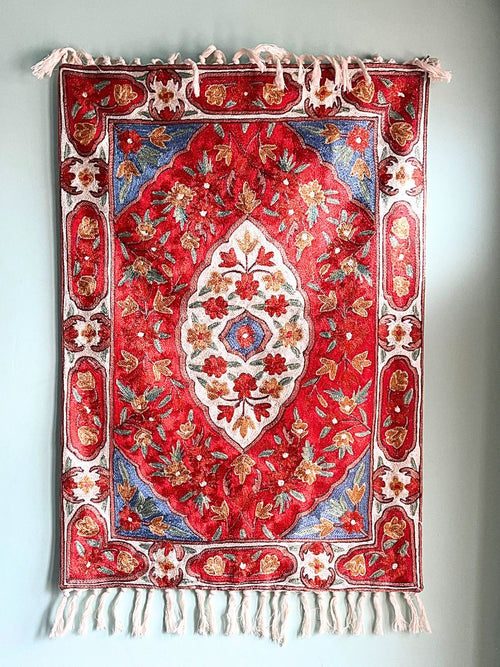
| Embroidery | Aari (chain stitch), sozni (fine needlework), tilla (metallic thread) |
| Worn with | Trousers, a salwar or churidar underneath; a shawl on top |
| Its day | Pheran Day, 21 December, the first day of Chillai Kalan |
What the word pheran means
The word is usually traced to the Persian perahan, a cloak or long shirt. English has no single word for it; "Kashmiri robe" or "Kashmiri winter cloak" comes closest. All the common spellings, pheran, phiran and feran, mean the same garment.
What a pheran is made of
A pheran is made to keep out a Himalayan winter, so the cloth is warm first and decorative second.
- Wool. The traditional winter pheran is wool. A woollen pheran was called a loch.
- Raffal. A fine, soft wool cloth woven in Kashmir, used for finer pherans.
- Tweed and jamawar. Tweed, and jamawar, a mix of wool and cotton.
- Cashmilon. A soft acrylic yarn made to look and feel like wool. It is warm, light and easy to look after, and it costs less than wool. It is acrylic, so it should be labelled cashmilon or acrylic, not wool.
- Velvet. For festive and bridal pherans, often with tilla.
- Cotton. Summer pherans are cotton, cut the same way, lighter to wear.
Under a winter pheran, Kashmiris traditionally wore a second, lighter one called the poots. It added warmth and protected against burns from the kangri.
How a pheran fits
A pheran is cut straight and worn loose. It is not shaped to the waist like a kurti, so one size fits most people. That wide cut has a purpose: in a Kashmiri winter the kangri, a small fire pot of clay in a wicker basket, is held inside the pheran, against the body, and the loose fall leaves room for it and for layers underneath.
- Length. The old pheran fell to the feet. Today most end below the knee, at the calf.
- Width. Generous all round, with room for layers and a kangri underneath.
- Sleeves. Wide and long, so a cold hand can be drawn inside.
- Opening. It goes on over the head. A short slit or a placket at the neck, sometimes with buttons, lets it on and off.
- Slits and pockets. Modern pherans often have side slits for ease of walking, and pockets at the sides.
Our Kashmiri pherans are free size: 48 to 52 inches around the bust and 42 to 44 inches long, fitting up to XL. Our pheran size guide shows where the hem falls at your height.
The design of a pheran
Most pherans share one shape, so the design lies in the cloth, the colour and where the embroidery sits.
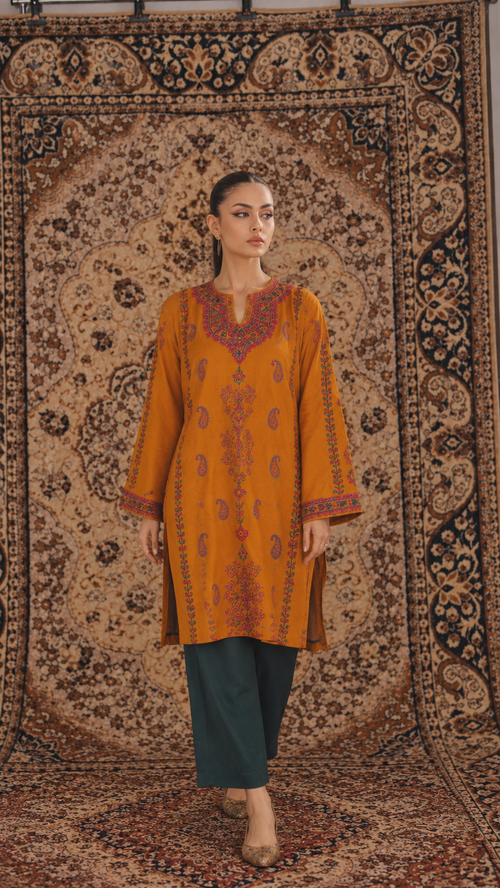
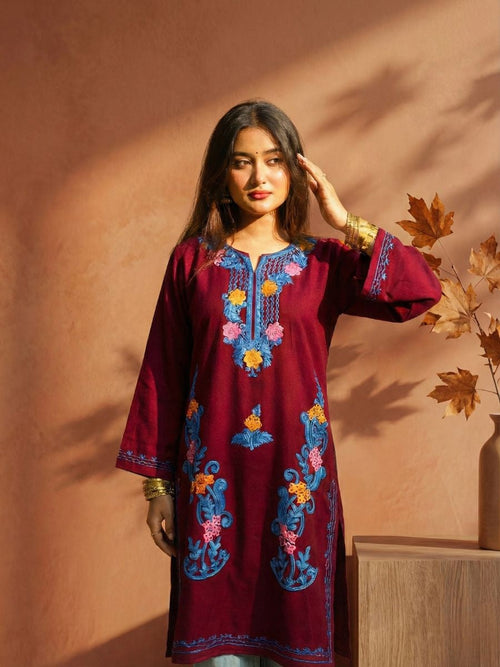
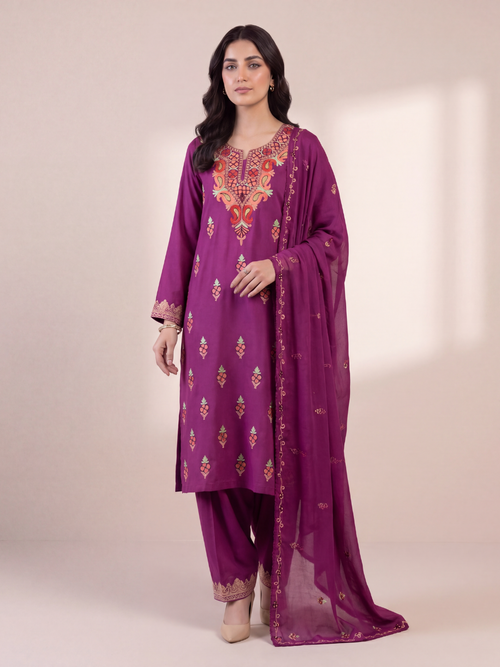
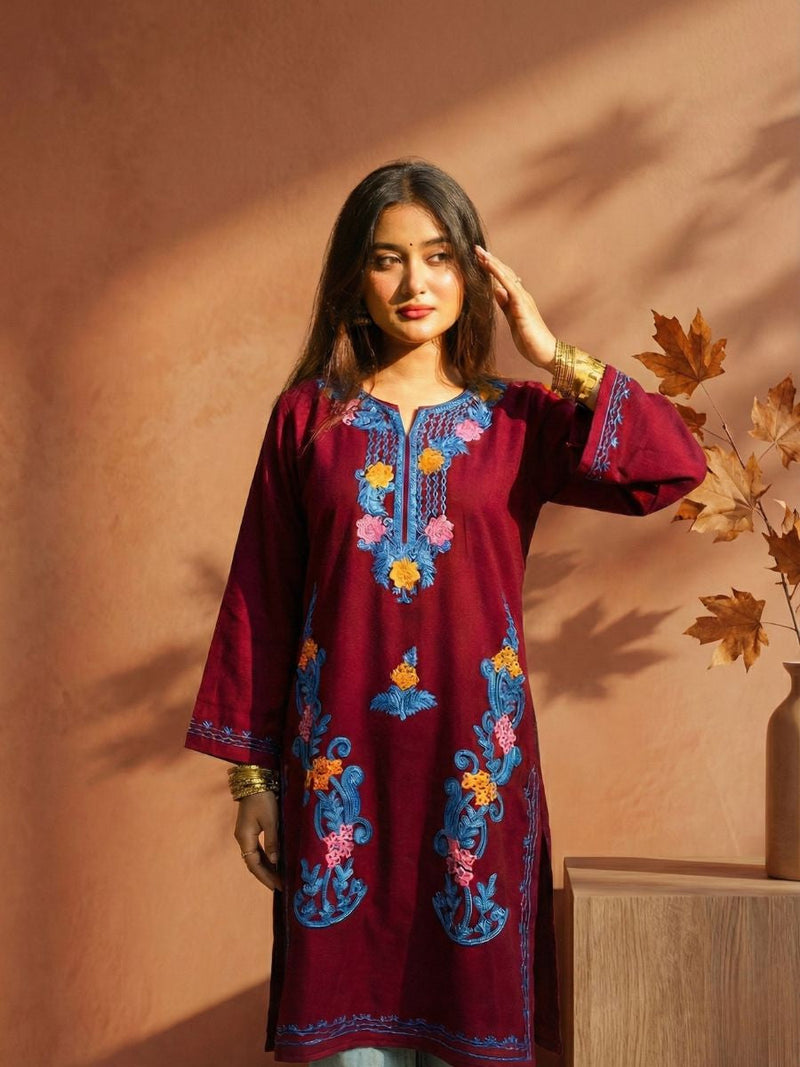
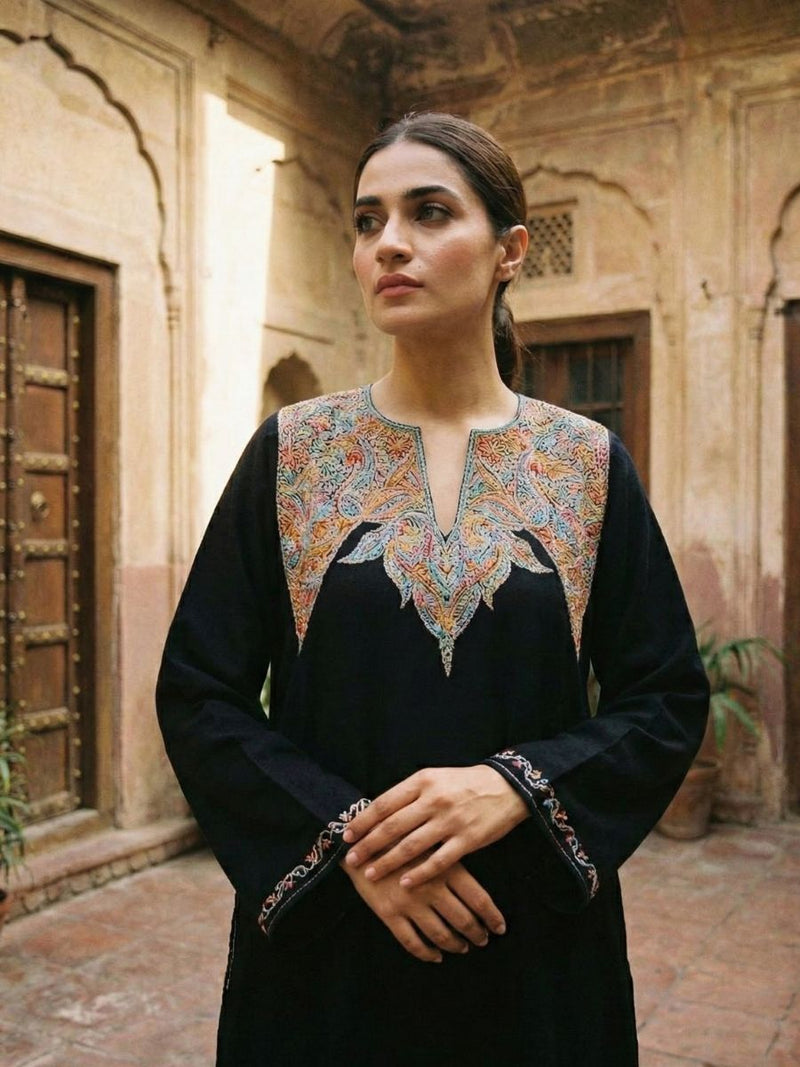
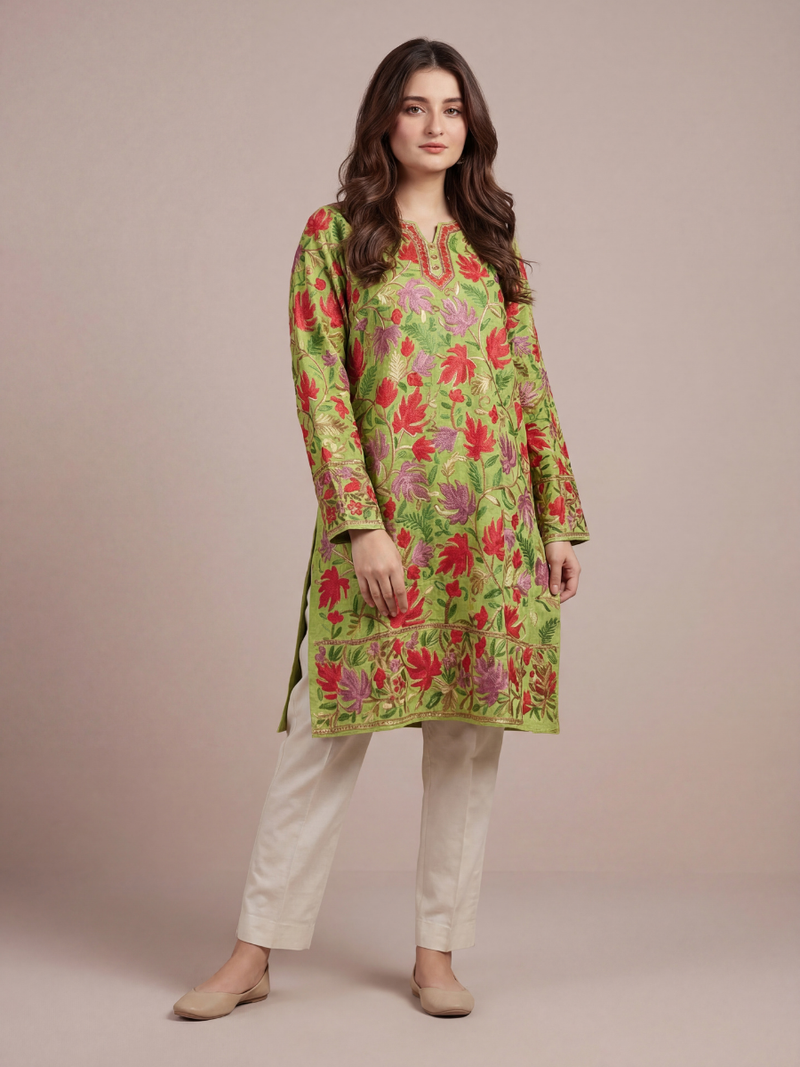
- The neck. The heart of the design: a panel of embroidery round the neck opening, running down the chest. On many pherans it is the only embroidery.
- The cuffs. A band of work at the end of each sleeve, matching the neck.
- The hem and sides. A border along the hem and up the side slits on more worked pieces.
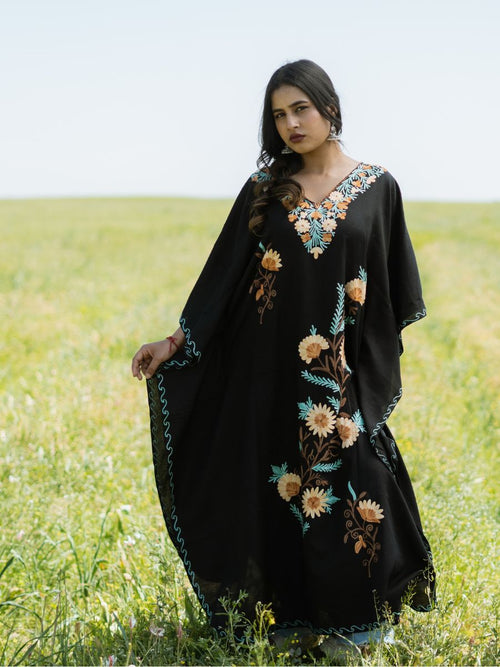
- Motifs. Kashmir's own: the chinar leaf of the valley's plane trees, pamposh (the lotus of Dal Lake), the paisley, and flowering creepers.
Three embroideries are used on pherans. Each has its own look:
| Embroidery | What it looks like | Where you see it |
|---|---|---|
| Aari | A looped chain stitch in bold, flowing floral lines | Everyday and winter pherans, usually at the neck and cuffs |
| Sozni | Fine, flat needlework in small, close motifs | Finer pherans and shawls; the most delicate of the three |
| Tilla | Gold or silver metallic thread that catches the light | Festive and bridal pherans, often on velvet or raffal |
Our guide to aari vs sozni vs tilla shows how to tell them apart.
The traditional pheran for men, and for women
A traditional men's pheran is simple: plain wool or tweed, with little or no embroidery. Women's pherans carry the colour and the needlework, with embroidery at the neck and cuffs and, on festive pieces, tilla or work along the hem. Both are cut the same way, loose and straight.
Pheran or kurta: what is the difference?
| Pheran | Kurta or kurti | |
|---|---|---|
| Worn | Over clothes, as an outer layer | As the main top |
| Season | Winter (cotton pherans in summer) | All year |
| Cut | Loose and straight, wide sleeves | Closer to the body |
| Cloth | Wool, raffal, cashmilon, velvet | Cotton, rayon, silk |
A pheran is warmer and roomier than a kurta, and made to go over one. Summer cotton pherans blur the line, but the wide sleeves and straight fall stay.
A short history of the pheran
The Chinese pilgrim Xuanzang, who came to Kashmir in the 7th century, described its people wearing a loose, gown-like leather garment. The pheran itself has been worn in the valley since before the 15th century. One account says the Mughal emperor Akbar brought the pheran when he took the valley in 1586; historians such as P. N. K. Bamzai trace the long robe instead to the Sufi saints and scholars who came to Kashmir from Persia and Central Asia. Either way, until the late 19th century the pheran that fell to the feet was worn across the valley, by Hindus and Muslims alike. Since then it has become knee-length. It was traditionally worn with nothing beneath it; suthans and churidars came in from the late 19th century, and the salwar from the 1960s.
The pheran never left. Kashmiris still put it on every winter, and it has had a revival as fashion, worn with jeans as easily as with a salwar. Every 21 December, Kashmir marks Pheran Day, at the start of Chillai Kalan, the forty days of hardest cold.
How the pheran is worn today
Over a thin kurta, a fitted top or a light sweater, with straight trousers, a churidar or jeans, a shawl over one shoulder, and simple shoes. In Kashmir it is worn to work, to the market and to weddings; across India it is worn as a warm, easy winter layer. Our guide on how to wear a pheran has outfits for every day and for festive wear.
Buying a Kashmiri pheran
- Ask what the cloth is. Cashmilon, raffal, wool or velvet. Each is fine; you should know which you are paying for.
- Look at the embroidery. Aari, sozni or tilla, and how much of the piece it covers: neck only, or cuffs, sides and hem too.
- Check the measurements. Bust (around the garment) and length matter more than a size label.
- Know the price. In October 2026 our pherans cost ₹1,250 to ₹4,200. Our pheran price guide explains what each band buys.
Our Kashmiri pherans are made in Kashmir and sent from Srinagar, with free delivery across India. The embroidered pieces are hand-assisted manual work; our Meeras pherans are hand-embroidered sozni on raffal wool. This winter's edit is the Haba Khatoon collection.
Questions
What is a pheran in English?
There is no exact English word. A pheran is a long, loose Kashmiri winter robe, worn over other clothes. "Kashmiri robe" or "Kashmiri cloak" is the nearest translation.
What is a Kashmiri pheran made of?
Traditionally wool. Today pherans are made in raffal wool, tweed, cashmilon (a soft acrylic), velvet for festive wear, and cotton for summer.
Is a pheran the same as a kurta?
No. A kurta is a top worn on its own. A pheran is a looser, warmer outer layer with wide sleeves, worn over a kurta or top in winter.
Why do Kashmiris wear the pheran?
For warmth. Its loose cut leaves room for layers and for the kangri, the small fire pot held under the pheran in the cold. It is also part of Kashmiri identity, worn by men and women alike.
Do men wear pherans?
Yes. Men's pherans are usually plain wool or tweed in dark colours, with little embroidery. Women's pherans are more colourful and embroidered.
When is Pheran Day?
21 December, the first day of Chillai Kalan, the forty coldest days of the Kashmiri winter.
How much does a Kashmiri pheran cost?
At KAARKASH in October 2026, pherans cost ₹1,250 to ₹4,200, with free delivery across India. Our pheran price guide explains what each price buys.
Is a pheran warm enough for Delhi or north India?
For a north Indian winter, a pheran over a kurta or a light sweater is usually enough. In colder places, add a thermal underneath.
Sources
- Pheran, Wikipedia, with its references to Bamzai (1962), Dewan (2004) and Xuanzang's account.
- Pheran Day, Wikipedia.
- KAARKASH product measurements and fabrics, October 2026.
Quoting this guide? You are welcome to: please link to it as "What Is a Kashmiri Pheran?", KAARKASH.
Written by the KAARKASH team in Srinagar, Kashmir, where our pieces are made and packed. Updated October 2026.