










Habba Khatoon: Kashmir's Poet-Queen and Her Story
In short: Habba Khatoon, also spelt Haba Khatoon, was a 16th-century Kashmiri poet. She was born Zoon in Chandhara, a saffron village near Pampore, and is remembered as the queen of Yusuf Shah Chak, often called the last independent sultan of Kashmir. Her songs of love and separation earned her the name "Nightingale of Kashmir".
Habba Khatoon at a glance
| What | The short answer |
|---|---|
| Also spelt | Haba Khatoon, Habba Khatun |
| Birth name | Zoon or Zooni, which means "moon" in Kashmiri |
| Born | Traditionally 1554, in Chandhara (Tsandhor), Pampore, Pulwama district |
| Married | First a peasant named Aziz; later Yusuf Shah Chak, sultan of Kashmir |
| Known as | The Nightingale of Kashmir |
| Her poetry | Kashmiri songs of longing and separation; the lol, a short lyric |
| Died | Traditionally 1609 |
| Grave | Athwajan, on the Srinagar-Jammu highway at the edge of Srinagar |
| Named after her | The Habba Khatoon peak in Gurez |
Who was Habba Khatoon?
Habba Khatoon is one of the best-loved poets in the Kashmiri language. She lived in the late 16th century, in the last years of Kashmir's own sultans. Born a farmer's daughter, she became, in the story every Kashmiri knows, a queen, and lost her husband when he was taken away for good. Her songs about that loss are still sung in the valley four hundred years later.
Much of her life comes to us through oral tradition rather than court records. So this page gives the story as it is told, and says plainly where historians disagree with it.
From Zoon to queen
She was born Zoon, or Zooni, the Kashmiri word for the moon. One legend says a Sufi mystic gave her the name for her beauty. Most accounts place her birth in 1554, in Chandhara, a village in Pampore about 20 km from Srinagar. Chandhara is still known as the "Saffron Village of Kashmir", and the saffron fields of Pampore are the country she grew up in. A separate legend says she was born to a chieftain in Gurez; most sources give Chandhara.
She learnt to read and write from the village teacher, and she sang. She was married young to a peasant named Aziz. The marriage was unhappy: the accounts speak of an unkind husband and harsh in-laws who disliked her singing, and it ended in divorce. (Sources give his name as Aziz Lone, Aziz, or Aziz Jan, a carpenter.)
The best-known part of the story comes next. Yusuf Shah Chak, out hunting, heard her singing under a chinar tree and stopped to listen. She came to the palace and took the name Habba Khatoon. Yusuf Shah became sultan in 1578 and, after losing and regaining the throne, ruled again from 1580 to 1586. Sources put her entry to the palace as early as 1570, and the dates do not sit neatly together.
Mohammad Ashraf, a former Director General of Tourism in Jammu and Kashmir, calls her the last queen of an independent Kashmir and writes that she advised her husband to be wary of the Mughal emperor Akbar.
Her poetry and the lol
Habba Khatoon is credited with bringing the lol (also written loal) into Kashmiri poetry. A lol is a short love lyric: a song built around one brief thought or feeling. Before her, the best-known Kashmiri verse was the vaakh, the short mystical verses of the 14th-century poet Lal Ded. Mohammad Ashraf writes that Habba Khatoon turned Kashmiri poetry from the Sufi spiritual school to a romantic "lol school". The linguist Braj Kachru wrote that she and the 18th-century poet Arnimal perfected the form.
Her subjects are love, waiting and separation. Many of her best-known songs are about longing for a beloved who has gone, and much of her finest work is said to date from the years after Yusuf Shah left. Her poems are still popular in Kashmir, most of all in the villages. She is also linked with Kashmiri music, and is credited with a musical composition called Raasti-Kashmiri.
It was this voice, as singer and poet, that gave her the title the Nightingale of Kashmir.
Exile and the last years
The Mughal emperor Akbar repeatedly asked Yusuf Shah to come to his court and pay homage. Yusuf Shah sent gifts and his sons instead. In February 1586 he submitted, and in March 1586 he was brought before Akbar and held. Kashmir became part of the Mughal empire that year.
Yusuf Shah never returned. He was kept a prisoner for about two and a half years. In 1589 Akbar released him, gave him a rank of 500 horse, and sent him to Bihar with Raja Man Singh. He died in September 1592 and is buried at Biswak, near Nalanda in Bihar.
Habba Khatoon stayed in Kashmir. Tradition says she lived about twenty more years, moving from place to place without possessions and singing of the husband she had lost; one account has her living in a small hut on the banks of the Jhelum. Most sources give 1609 as the year of her death.
Legend and history
Her story is loved, and it is also argued over. Three points are worth knowing:
- Was she queen? Popular tradition says so. Some scholars ask whether she was a lower-ranking companion in the royal household. A 2025 Greater Kashmir column goes further: it argues she was not his wife at all, because the Persian and Kashmiri chronicles of the time name no wife called Habba Khatoon.
- Dates. The usual years, 1554, about 1570 and 1609, rest on tradition and later writers, and they do not fit neatly with the dates of Yusuf Shah's reign. Sources even differ on when he first took the throne (1578 or 1579), and one account puts the couple's separation in 1579 rather than 1586.
- Her grave. Most sources place it at Athwajan. A claim also circulates that she lies at Biswak in Bihar beside Yusuf Shah; the same column says that grave belongs to his other wife, the mother of his son Yaqub.
None of this changes her place in Kashmiri poetry. The songs are there either way.
Where she is remembered today
- Athwajan. Her grave is at Athwajan, on the Srinagar-Jammu highway on the outskirts of Srinagar. The structure over it was built in 1950 under the supervision of the poet Mahjoor. Live History India describes it as largely ignored.
- Gurez. A pyramid-shaped mountain in the Gurez valley in north Kashmir is called the Habba Khatoon peak, and local legends gather around it.
- Chandhara. Her home village in the saffron fields of Pampore is remembered as her birthplace.
- Film. Several films about her were planned and never finished. The best known, Muzaffar Ali's Zooni with Dimple Kapadia, was shelved around 1990.
- Song. Above all, she is remembered whenever her songs are sung.
The Haba Khatoon pheran line
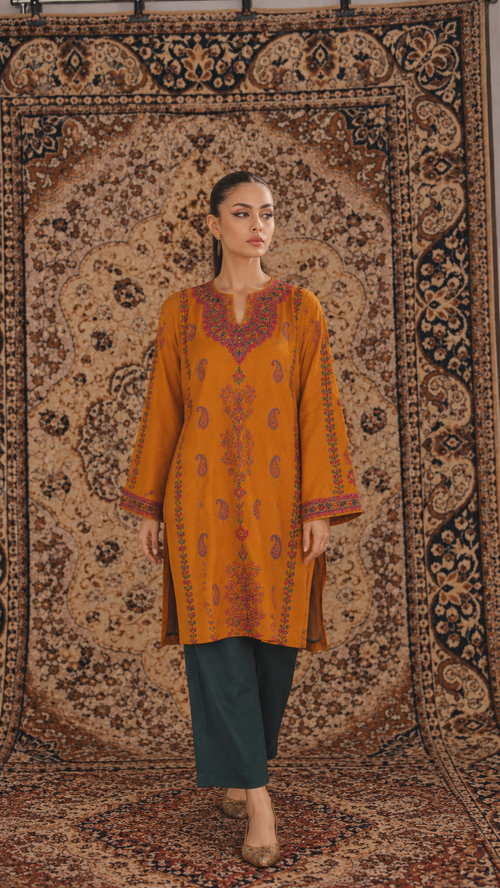
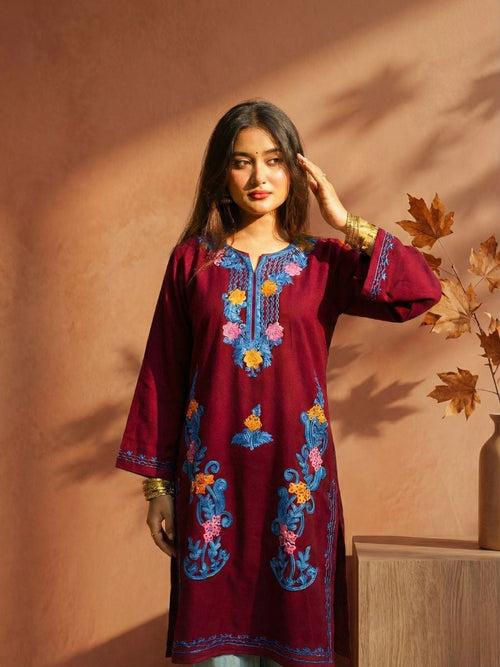
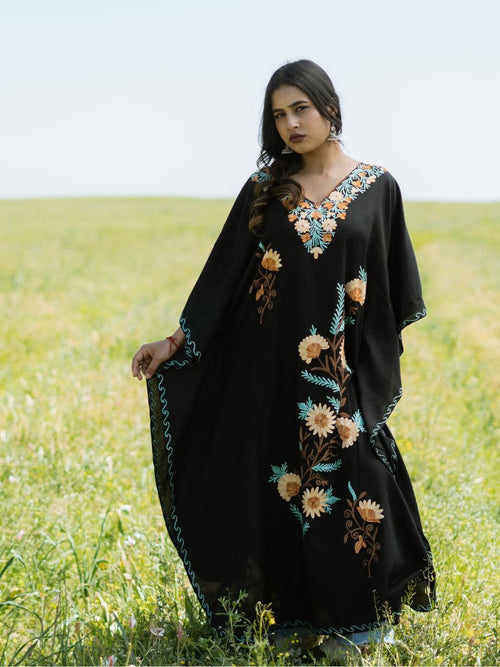
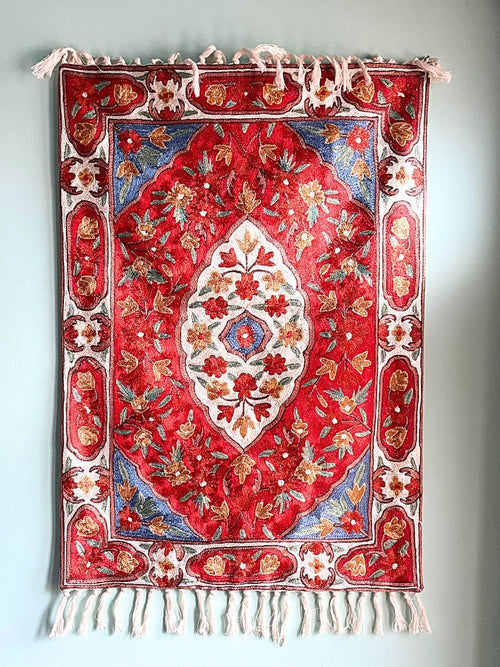
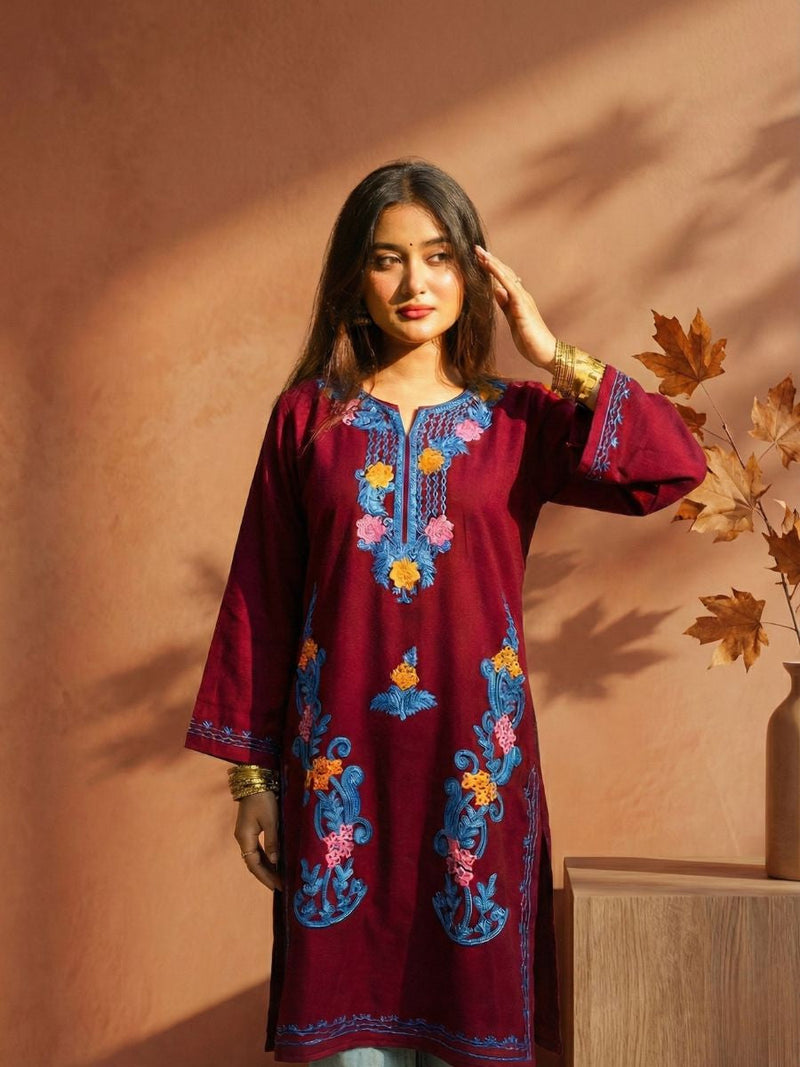
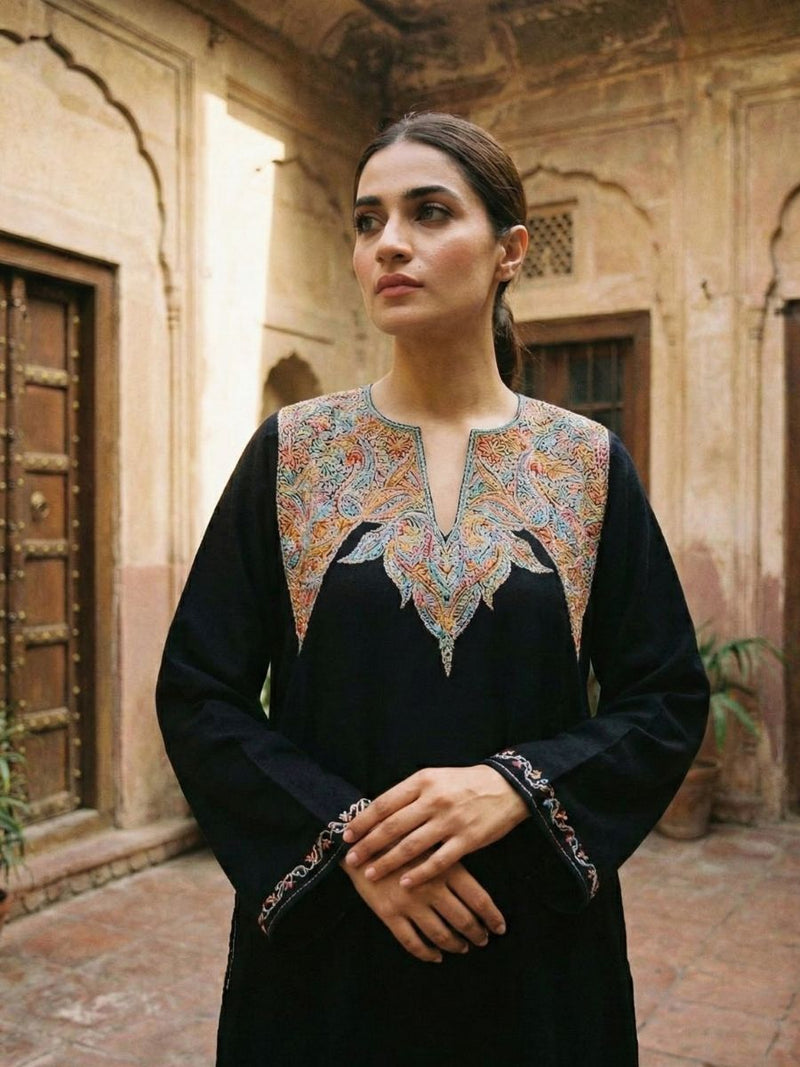
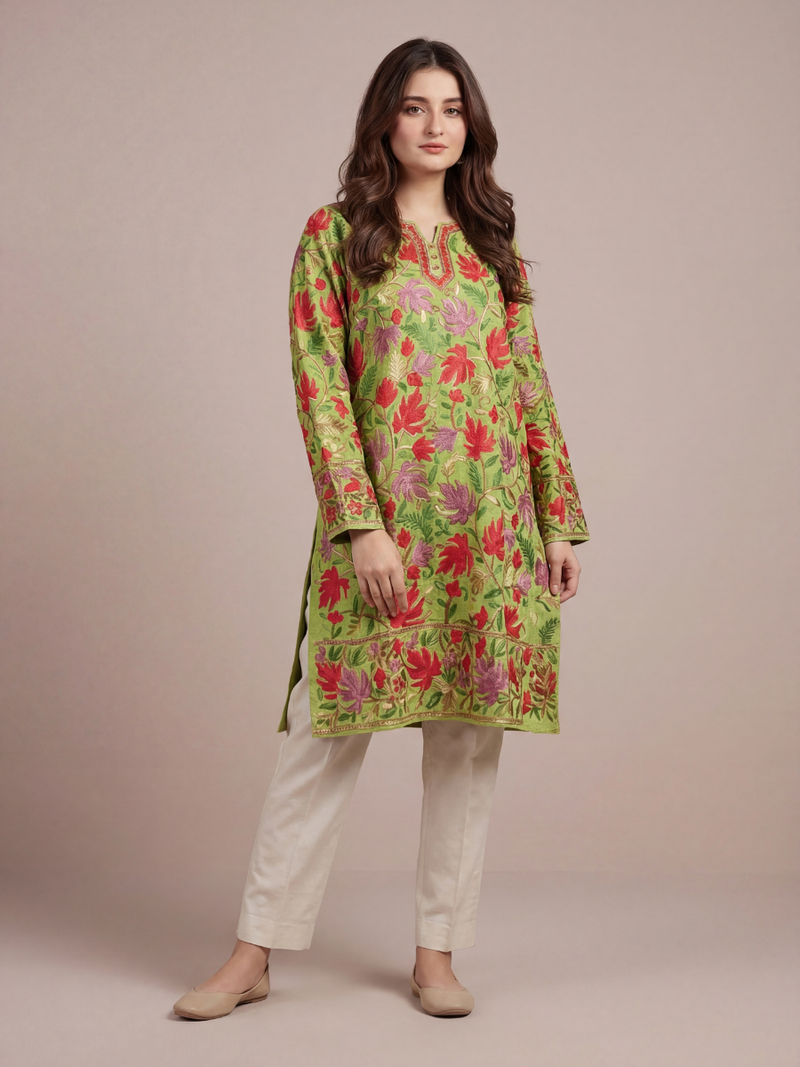
KAARKASH named this winter's pheran line after her, in her honour. It is not a copy of anything she wore, and no one connected with her has endorsed it. We chose the name because she is a daughter of Pampore, about 20 km from Srinagar where we work, and because the chinar, the tree under which Yusuf Shah is said to have first heard her sing, is one of the motifs on these pherans.
As of 22 October 2026 the Haba Khatoon collection has 106 pherans in stock, priced from ₹1,450 to ₹4,200. All come in one size, L - XXL. It has four lines:
- Aari. Most of the collection. Cashmilon, a soft acrylic, with aari chain-stitch embroidery at the neck and borders, in floral, paisley, chinar-leaf and pamposh (lotus) designs. Most pieces are ₹1,499.
- Manual Aari. Cashmilon with aari work, ₹2,199.
- Sozni. A few pieces in fine sozni needlework, ₹1,450 to ₹4,200.
- Tilla. Golden boti tilla on pure raffal wool, ₹1,499.
The aari pherans measure about 48 to 50 inches around the bust and 42 to 44 inches long, with pockets on both sides. The embroidered pieces are hand-assisted manual work, made in Kashmir, so thread colours can differ slightly from piece to piece. Delivery is free across India: prepaid orders usually arrive in 3 to 5 days, and cash on delivery, available for most pincodes, in 8 to 13. New to pherans? Start with what a Kashmiri pheran is, and see aari vs sozni vs tilla to tell the three embroideries apart.
Questions
Who was Habba Khatoon?
A 16th-century Kashmiri poet, born Zoon in Chandhara near Pampore. She is remembered as the queen of Yusuf Shah Chak, often called the last independent sultan of Kashmir, and for her love songs in Kashmiri.
Why is she called the Nightingale of Kashmir?
For her singing and her songs. She was a singer as much as a poet, and her lyrics of love and longing are still sung across the valley.
What is a lol?
A short Kashmiri love lyric built around one brief thought or feeling. Habba Khatoon is credited with bringing it into Kashmiri poetry, and with the later poet Arnimal is said to have perfected it.
Where is Habba Khatoon buried?
At Athwajan, on the Srinagar-Jammu highway on the outskirts of Srinagar. A competing claim places her at Biswak in Bihar, but most sources give Athwajan.
Was Habba Khatoon really a queen?
Kashmiri tradition says she was Yusuf Shah Chak's queen. Some historians question it, and one 2025 column argues she was not his wife at all, because the chronicles of the time do not name her. Her poetry is not in doubt.
Is the KAARKASH Haba Khatoon pheran linked to her?
Only by name. It is our winter line, named in her honour. It is not a historical costume and is not endorsed by anyone connected with her.
Sources
- Habba Khatoon, Wikipedia, with its references to S. L. Sadhu, Haba Khatoon (Sahitya Akademi), S. N. Wakhlu, Habba Khatoon: The Nightingale of Kashmir (1994), and Braj B. Kachru, Kashmiri Literature (1981).
- Yusuf Shah Chak, Wikipedia, drawing on the Baharistan-i-Shahi and the Akbarnama.
- Mohammad Ashraf, "Kashmir's Women Rulers", Countercurrents, 4 August 2016.
- Habba Khatoon, Adbi Markaz Kamraz.
- B. L. Razdan, "The Nightingale of Kashmir", Greater Kashmir, 2 January 2025.
- Peerzada Abdal Mehjoor, "Debunking the Myth", Greater Kashmir, 17 October 2025.
- Kritika Sarda, "Habba Khatoon: Kashmir's Poet Queen", Live History India, 2017.
- Arya Daoo, "Habba Khatoon: The Greatest Poet and Peasant Queen of Kashmir", Feminism in India, 19 January 2023.
- Kashmiri literature, Chandhara and Gurez, Wikipedia.
- KAARKASH Haba Khatoon collection: stock, prices, fabrics and measurements as listed on 22 October 2026.
Quoting this guide? You are welcome to: please link to it as "Habba Khatoon: Kashmir's Poet-Queen", KAARKASH.
Written by the KAARKASH team in Srinagar, Kashmir, where our pieces are made and packed. Updated October 2026.